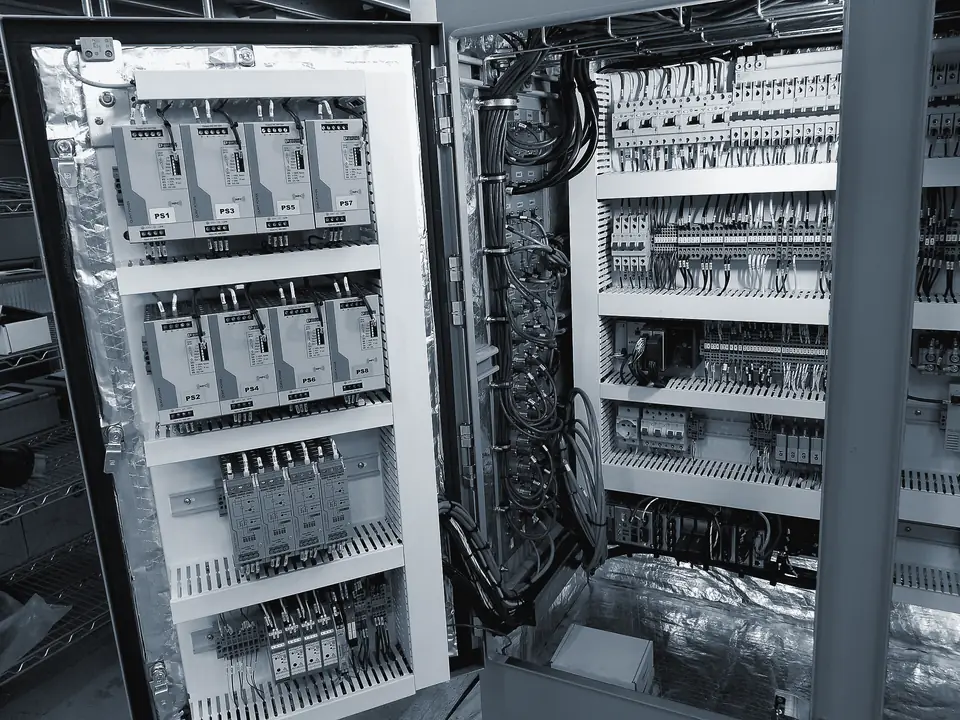
The market offers thousands of controllers, modules and gateways. Even so, sites regularly present tasks that off-the-shelf equipment cannot solve, or can only solve at too high a cost. That is when it makes sense to develop a custom device.
When custom development makes sense
- No ready-made solution: you need specific logic or a combination of functions that no manufacturer offers.
- Non-standard interfaces: legacy equipment with a closed protocol has to be connected to a modern system.
- Scale: dozens of identical sites where an off-the-shelf solution costs considerably more.
- Control: you need to own the logic and updates without depending on a third-party manufacturer's plans.
If a certified off-the-shelf device does the job, we recommend it. Custom development is a tool, not an end in itself.
What the solution consists of
- Hardware platform: a microcontroller or single-board computer, relay and input boards, interfaces (RS-485, Ethernet, Wi-Fi), power supply and enclosure.
- Firmware: operating logic, data exchange, failure handling.
- Server side: centralized management, configuration, logs, updates.
- User interface: a web panel for configuration and monitoring.
Reliability is the key requirement
For security systems it is not enough for a device to "work on the bench". It has to run unattended for years in real conditions. Here is what we build in:
- Hardware watchdog: an independent circuit that restarts the device if the program hangs.
- Safe output state: during a reboot or failure, relays go to a defined safe state.
- Local storage of settings: the device keeps working with its last configuration even without a connection.
- Connection monitoring: loss of connection becomes a separate fault signal, not "all OK".
- Correct error handling: a network error is never interpreted as a change in the site's state.
- Safe updates: with verification and rollback capability.
Example: AB-ALERT
Our product AB-ALERT is an embedded solution from schematic to web panel. The device, based on a single-board computer with an 8-relay board and an audio output, polls the server, controls the relays according to configured logic and plays voice messages. A hardware watchdog, local storage of settings and a dedicated fault relay make it suitable for unattended operation.
From prototype to production
We start with a prototype and trials at a real site, bring the solution to a stable release, document it and roll it out with centralized management of the device fleet.
More details on the "Embedded Solutions" page.