In a server room, switchroom or archive, a fire can destroy not only equipment but also data and documents. Water and powder put out the fire but cause damage no less than the fire itself. That is why such rooms use gas fire suppression.
How it works
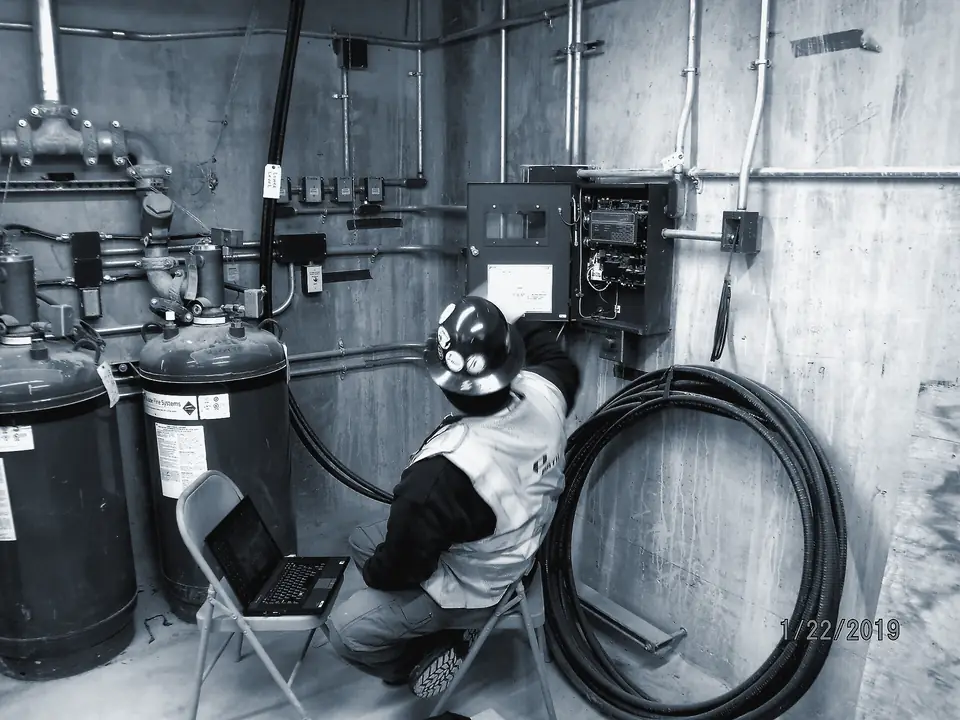
A gas fire suppression system discharges a gaseous extinguishing agent into the protected room, which stops combustion either by lowering the oxygen concentration (inert gases) or by chemically inhibiting the combustion reaction (chemical agents). After extinguishing, the room is ventilated, and the equipment needs no cleanup.
Where it is used
- server rooms and data centers;
- switchrooms, transformer rooms, cable rooms;
- archives, libraries, museum storage;
- telecom nodes, control rooms;
- rooms with expensive process equipment.
Types of gaseous agents
| Type | How it extinguishes | Features |
|---|---|---|
| Inert gases (nitrogen, argon, their blends) | lower the oxygen concentration | require large storage volumes, environmentally safe |
| Chemical agents | inhibit the combustion reaction | compact storage, design concentration reached quickly |
| Carbon dioxide (CO₂) | displaces oxygen | effective but dangerous to people at extinguishing concentration; limited use |
The choice of agent depends on the room type, occupancy, volume, required extinguishing speed and available space for the cylinders.
Room integrity is the key to success
The gas must be held in the room for the required time. If the room has unsealed openings, unsealed cable penetrations or gaps, the gas escapes quickly and the concentration drops below the extinguishing level. That is why during design and commissioning we assess room integrity and specify sealing measures. Pressure relief vents are also provided so that the gas discharge does not damage the structure.
Life safety
Modern systems must have:
- visual and audible warnings before gas discharge;
- a discharge delay so people can get out;
- automatic release inhibit when the doors are open;
- "Gas – do not enter" and "Gas – leave the room" signs;
- manual release and abort controls near the entrance.
How it is designed
- Room analysis: volume, integrity, occupancy, equipment.
- Selection of the extinguishing agent and design concentration.
- Calculation of agent mass and number of cylinders.
- Hydraulic calculation of the pipework and nozzle layout.
- Design of the control and fire detection system, often with two independent detectors per zone for confirmation.
- Specification and cost estimate.
Maintenance
The system requires regular checks: agent pressure and mass in the cylinders, condition of pipework and nozzles, operation of release devices and controls. Cylinders are periodically recertified as required. We carry out maintenance and arrange refilling.
Learn more about all suppression methods on the Fire Suppression page.